
I think about her often, actually.
Thirty-two years in a classroom. She had a way of walking into a room like she owned it — lipstick on, chin up, not a hair out of place. Her former students still called her on her birthday.
By the time her family brought me in, she was somewhere in the middle stages of dementia. They were good people doing everything right. Medications managed. Meals scheduled. Doctor visits on the calendar.
Her mouth, though. Nobody had gotten there.
When I did a gentle assessment, what I found was months of unaddressed pain. Plaque, inflammation, two teeth that needed immediate intervention. She had no way to tell her family any of this was happening. And they had no reason to think to look.
I sat with that for a while after.
Because this is the gap. This is exactly where oral care for dementia patients falls through. Not because families do not care — they clearly do. But because nobody told them this was part of the job.
So today, let’s talk about it.
Table of Contents
Why Dementia Makes Oral Care More Difficult
The Mouth-Brain Connection You Need to Understand
Warning Signs Every Caregiver Should Know
A Practical Daily Oral Care Framework
When Patients Resist: Compassionate Strategies That Work
When to Involve a Dental Professional
Final Thoughts
FAQs
Why Dementia Makes Oral Care More Difficult
Here is the thing about dementia that most people outside of care work do not fully grasp.
It does not just take memory. It changes how a person experiences everything around them — including someone coming at them with a toothbrush.
Think about that for a second from their perspective. A person approaches. Something is moving toward your face. You do not fully understand why. That is frightening for anyone.
So when a dementia patient clenches their jaw, turns their head, pushes the caregiver’s hand away — that is not attitude. That is a person responding to something that feels threatening to them in that moment.
It is the disease. Not the person.
There is also the pain communication issue, which is honestly one of the harder parts of this work. A senior with moderate to advanced dementia may be sitting with a genuine toothache and have no pathway to tell anyone. What comes out instead is agitation. Refusal to eat. Changes in mood. Behaviors that look like a hundred other things.
According to the Centers for Disease Control and Prevention (CDC), nearly 68 percent of adults aged 65 and older already have some form of periodontal disease — and that number climbs significantly for people living with dementia, where daily oral care is harder to sustain consistently.
Harder. Not impossible. There is a difference.
The right approach matters enormously here. And once you have it, things change.
The Mouth-Brain Connection You Need to Understand
I want to share something that shifted how I think about this work entirely.
The mouth and the brain are not separate systems. What happens in one absolutely affects the other — and in the context of dementia, this connection is something families and care teams need to understand.
Oral bacteria, particularly the strains associated with gum disease, have the ability to travel through the bloodstream. Researchers have actually found evidence of these bacteria in the brain tissue of Alzheimer’s patients. That research is ongoing, but the connection is real enough that it has changed clinical conversations.
Then there is aspiration pneumonia. This happens when bacteria from the mouth gets inhaled — even in tiny amounts — into the lungs. It is one of the leading causes of death in late-stage dementia. And it is directly linked to the state of the mouth.
The World Health Organization reports that oral diseases affect approximately 3.5 billion people globally. Older adults carry far more than their fair share of that number.
3.5 billion.
For someone with dementia, the compounding factors are significant. Medications that dry out the mouth. A weakened immune response. Difficulty swallowing. Each one adds another layer of vulnerability.
When we do good oral care for a person with dementia, we are not just cleaning teeth. We are reducing infection risk. We are protecting the lungs. We are doing something that genuinely matters for how long and how well that person lives.
That is the weight of this work. It is worth carrying.
Warning Signs Every Caregiver Should Know
None of these require a clinical background to spot. They just require someone who is paying attention.
Eating has changed. Not just appetite — the actual mechanics of eating. Avoiding hard foods, chewing on one side, taking much longer than usual, pushing the plate away after a few bites. These can all point to oral pain.
Mealtime has become stressful. If a senior who was once comfortable at the table is now agitated, tearful, or resistant around food and drink, do not assume it is behavioral. Investigate.
Something looks different in the mouth. Gums that are red or pulling away from the teeth. White patches on the tongue or cheeks. Spots on teeth that were not there before. Sores that have not healed in a week or two. Any of these need eyes on them.
The breath is not improving. Everyone’s breath is not great in the morning. But persistent odor that does not clear up with brushing, day after day, usually means something is happening deeper than the surface.
There is visible swelling. Around the jaw. Under the chin. In the cheek. This is not something to monitor at home. This is a same-day call to a dental provider.
The hard truth is that these signs show up quietly. They build slowly. And in the middle of a full caregiving day, they are easy to miss.
But they are there. And catching them early changes everything.
A Practical Daily Oral Care Framework
Let’s get practical. Because awareness without action is just worry.
Find the right time of day. This matters more than people realize. A dementia patient who is calm and cooperative at 9am may be completely different by mid-afternoon. Learn their patterns. Build the oral care routine into the window when they are most settled — usually after breakfast, sometimes after an early dinner.
Prepare the space. Lower the noise. Turn off the TV if it is on. Approach from the front, slowly, so you are not coming at them from an unexpected angle. Tell them what you are doing before you do it. “I’m going to help clean your teeth now. I’ll be gentle.” Say it like you mean it — because you do.
Soft brush, small amount of fluoride paste. For patients who resist a standard toothbrush, try a foam swab or a finger brush first. The goal is getting something in there, not winning a battle. If swallowing is a real concern, a fluoride gel that does not require rinsing is a good option.
Work the gumline. That is where the buildup happens. Small, gentle circles at the point where the gum meets the tooth. Twice a day consistently beats once a day aggressively.
Dentures need the same attention. If the person wears dentures, they come out every night, get scrubbed on every surface, and soak properly. Bacteria on dentures are directly linked to aspiration risk. This is not optional.
Hydration is part of oral care. Dry mouth is extremely common in this population — most of it medication-related. Regular sips of water through the day. A dry mouth spray if needed. No alcohol-based rinses. A moist oral environment is a far less hospitable one for harmful bacteria.
When Patients Resist: Compassionate Strategies That Work
Resistance is part of this. It is going to happen. The question is what we do with it.
I worked with a gentleman once — memory care facility, mid-stage dementia — who had turned oral care into a daily standoff. Jaw clenched the moment the toothbrush appeared. Every caregiver on the floor had tried. Nothing stuck.
We backed all the way up. His regular caregiver started just sitting with him in the mornings, no agenda. Talking about his garden, the one he used to keep. Humming songs he would sometimes finish the words to. One morning she handed him the toothbrush just to hold.
He put it in his mouth himself.
It took three weeks of a completely different approach before assisted brushing became possible. Three weeks of choosing relationship over compliance.
That is what this work actually looks like sometimes.
Hand-over-hand works. Put the brush in their hand. Put your hand over theirs. Guide rather than do. It preserves their sense of being the one in control, which matters deeply to people whose control over their own life has been significantly reduced.
Distraction is a real technique. A familiar song playing softly. Something they like to hold in the other hand. A topic of conversation they always respond to. Shifting their attention slightly can open a window.
Partial is fine. Front teeth today. More tomorrow. Do not make any one session into a mountain. Consistency over time is the whole game.
Stop when you need to stop. Forcing through strong resistance causes trauma. It makes the next attempt harder. It is always better to exit calmly and return later than to win the moment and lose the relationship.
Resistance is communication. It is telling us something.
Our job is to figure out what — and adjust accordingly.
When to Involve a Dental Professional
Good daily care at home is essential. It is also not sufficient on its own.
Dementia patients need regular professional oral assessments. Ideally from someone with specific experience in geriatric dental hygiene, because the approach required is genuinely different. It is slower. It has to be adapted in real time. It requires understanding the intersection of cognitive impairment, medication effects, and oral health in ways that general dental training does not always cover.
When you connect with a provider, share everything — the patient’s current stage, what triggers resistance, what has worked at home. That information is useful. Use it.
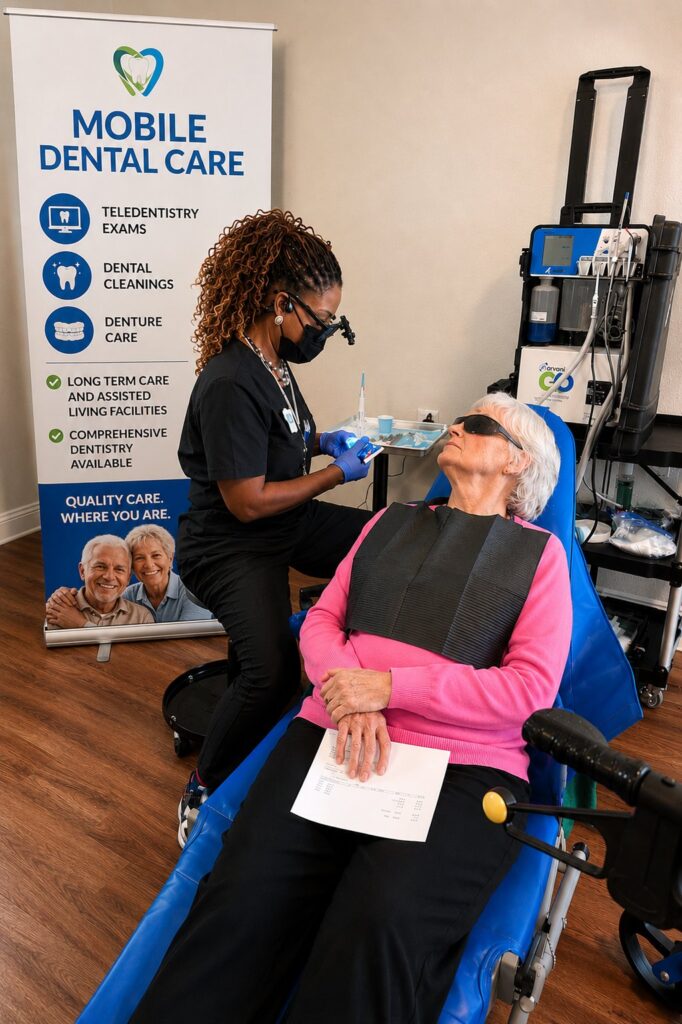
And for patients who simply cannot get to a clinic, mobile dental hygiene services exist for exactly this reason. The care goes to the patient. To the home. To the facility. Wherever they are, that is where we bring it.
No one should be going without professional oral care because getting there is too hard.
Final Thoughts
What I carry from thirty-plus years in this field is pretty simple.
The mouth tells a story. And for people with dementia, it often tells the only version of that story that has no way to be spoken out loud.
Pain they cannot name. Infection we have not found. Discomfort they are carrying alone.
When we step into that gap — when we make oral care part of the actual care plan and not an afterthought — we are doing something real. Something that protects their health and honors their dignity at the same time.
So I want to ask you directly.
Are we truly caring for the whole person — or have we been stopping just short of the mouth?
Because that is where so many of them are waiting for us.
If you are ready to build real expertise in this area, I invite you to explore the Geriatric Oral Care Certification. The forgotten mouths in our care deserve someone who will not forget them.